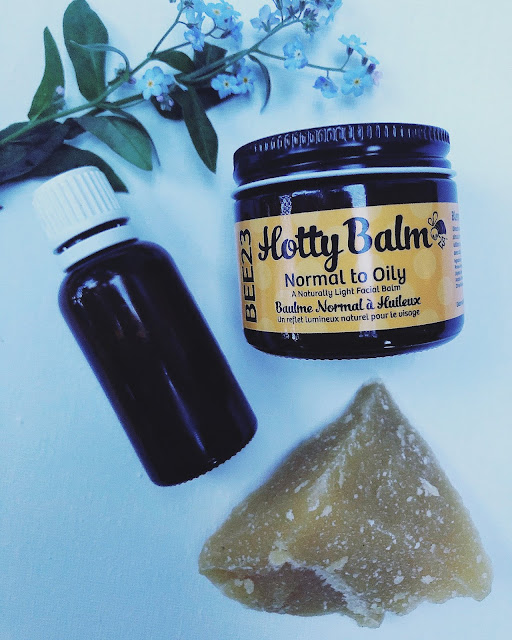
Why we LOVE lavender for Skin Care & our Dream Mist DIY!

Our DIY Dream Mist from our Monday Tea with BEE23 included one of our fave ingredients lavender. Not everyone loves lavender but used in the correct amount in a formula along with beeswax, it creates a jam-packed blend with dreamy skin promoting elements.  Our Normal to Oily Hotty Balm has just the right touch of lavender to help reduce inflammation, blemishes and acne-causing bacteria.  Lavender oil has antibacterial properties that help to kill acne-inducing bacteria and clogged pores. By unclogging pores and reducing inflammation when you put it on your skin, lavender helps prevent acne from developing while treating existing blemishes.  Similar to the calming effects of lavender scent, it can soothe irritated skin as well due to its natural anti-inflammatory properties. As a result, lavender may help treat certain skin conditions, such as eczema or psoriasis. By the same token, lavender can help to treat sunburns and other pain and inflammations of the skin.  Some research indicates that lavender oil may promote the healing of skin tissue. In which case, next time you have a cut, scrape, or another wound, reach for the lavender oil to help speed up the healing process!  As lavender contains antioxidants, it may help protect against damaging free radicals which can dramatically age the skin. These free radicals are at least partly responsible for the development of fine lines and wrinkles on the face so blocking them with an antioxidant could have some anti-ageing effects.

Our DIY Dream Mist from our Monday Tea with BEE23 included one of our fave ingredients lavender.
Not everyone loves lavender but used in the correct amount in a formula along with beeswax, it creates a jam-packed blend with dreamy skin promoting elements.

Our Normal to Oily Hotty Balm has just the right touch of lavender to help reduce inflammation, blemishes and acne-causing bacteria.

Lavender oil has antibacterial properties that help to kill acne-inducing bacteria and clogged pores. By unclogging pores and reducing inflammation when you put it on your skin, lavender helps prevent acne from developing while treating existing blemishes.

Similar to the calming effects of lavender scent, it can soothe irritated skin as well due to its natural anti-inflammatory properties. As a result, lavender may help treat certain skin conditions, such as eczema or psoriasis. By the same token, lavender can help to treat sunburns and other pain and inflammations of the skin.

Some research indicates that lavender oil may promote the healing of skin tissue. In which case, next time you have a cut, scrape, or another wound, reach for the lavender oil to help speed up the healing process!

As lavender contains antioxidants, it may help protect against damaging free radicals which can dramatically age the skin. These free radicals are at least partly responsible for the development of fine lines and wrinkles on the face so blocking them with an antioxidant could have some anti-ageing effects. 

Beeswax also carries antiviral, anti-inflammatory, and antibacterial properties that are essential in fighting chapped skin and bacterial infections that tend to affect us most in the dry, winter months or when over-washing our hands! It forms a protective wall by sealing in moisture in our skin without smothering and clogging up the pores. We source our beeswax from local small farmers through Bees Are Life on St. Claire Avenue West in Toronto, Ontario.

DIY DREAM MIST & PILLOW SPRAY 


Ingredients & Supplies:
  • 20ml Witch Hazel (or Rubbing Alcohol). We used Witch Hazel. You need to use unscented witch hazel, isopropyl or rubbing alcohol which acts as a preservative and a carrier.
  • 70ml Distilled Water OR Deionized Water
  • 40 drops of calming Essential Oils (lavender, sweet orange, roman chamomile)
  • 100ml Spray Bottle (preferably Amber Glass)
  • 1 Measuring Cup with a pouring spout
  • 1 Small Funnel

Instructions:

  1. Measure all ingredients and combine in your measuring cup.
  2. Use a funnel to pour your mixture into your spray bottle. Tighten the cap.
  3. Swirl the bottle around to combine.

To use: Before spraying, give the bottle a good shake to redistribute the ingredients, otherwise, the oils settle on top. Spray 3-4 times onto your pillow before laying down or spritzing lightly onto the body or pyjamas of most adults. Allow a minute for the alcohol to evaporate and the essential oil aroma to develop. Lay your head down on your pillow and slowly inhale and exhale deeply through your nose. Continue your deep, slow breathing for 5 minutes, as this will help calm you and aide in getting off to sleep.  Note: If you would like to use it directly on pregnant women or children, it is recommended to select extra-safe essential oils (such as lavender essential oil) and reducing the amount of essential oils to 12 drops or less. 
To check out all of our products with lavender take a look for the yellow labels at www.bee23.ca!

Comments

Popular posts from this blog

High Vibe Matters ~ What is the Frequency of Your Products!?

A Few Notes on Frequency and Why it Matters to your Skin and Body! We are in the glorious 're-membering' of incredible wisdom that was momentarily veiled from our communities. Nonetheless, not unlike our fearless and resilient dandelion allies, such sacred knowing can be stamped on, subjugated, ignored, buried, polluted, poisoned and pulled out BUT it keeps popping its little lion maned yellow head up to say, "I'm still here!" I wanted to put a few notes together to get our community thinking about the importance of the frequency of what we utilize on the daily, whether that is in consuming, wearing or in our bath and beauty products. I have maintained over the years you cannot put non-living dead frequency on living frequency and expect life. It's simply not possible.  The frequency of the human body typically ranges from 62 to 78 MHz when healthy, with disease starting to occur when it drops below 58 MHz. Each organ also has its own specific frequency, co...

Reach for Plants ~ Rhodiola to the Rescue

Reach for Plants ~ Rhodiola to the Rescue The other day I was feeling off, stressy and overwhelmed. I feel it has a lot to do with the constant unseasonable rain and cloud cover. After unsuccessful attempts to redirect my mood, I decided to have a time out and it popped in my head to add some Rhodiola rosea to my Kombucha. It felt as if only minutes had passed, and this lightness came over me. The heavy overwhelm lifted, my mood noticeably softened. It is a good reminder that our plant allies are there at the ready to help! Studies have found rhodiola may help strengthen the body’s response to physical stressors like exercise and psychological stressors such as fatigue and depression. Other studies, many in test tubes and animals, have suggested that rhodiola may help protect against certain health conditions, such as cancer, depression, and diabetes. However, more research is necessary to quantify how traditional medicine already uses this herb. Rhodiola has been used in trad...

Green Tea the Forgotten Collagen & Metabolism Plant Ally

 Green Tea the Forgotten Collagen & Metabolism Plant Ally With so much attention on new trends for weight management, blood sugar balance, and skin firming, I want to highlight an ancient plant ally that may not seem exciting but deserves a place in a daily beauty and wellness routine. Green tea is an important part of my plant-based toolkit. I include it in my morning blend of black tea, five mushroom powder, and a dandelion-chicory coffee substitute. It is also a key ingredient in my Brighten + Fortify Facial Serum , which I use every day. In addition to its well-known skincare benefits, studies suggest that green tea may help regulate blood sugar, improve insulin sensitivity, and support overall metabolic health, making it a valuable part of a whole-body weight management approach. How Green Tea Works Green tea’s many benefits for skin health, weight management, and blood sugar support are largely linked to its bioactive compounds, especially catechins and EGCG (epigallocat...